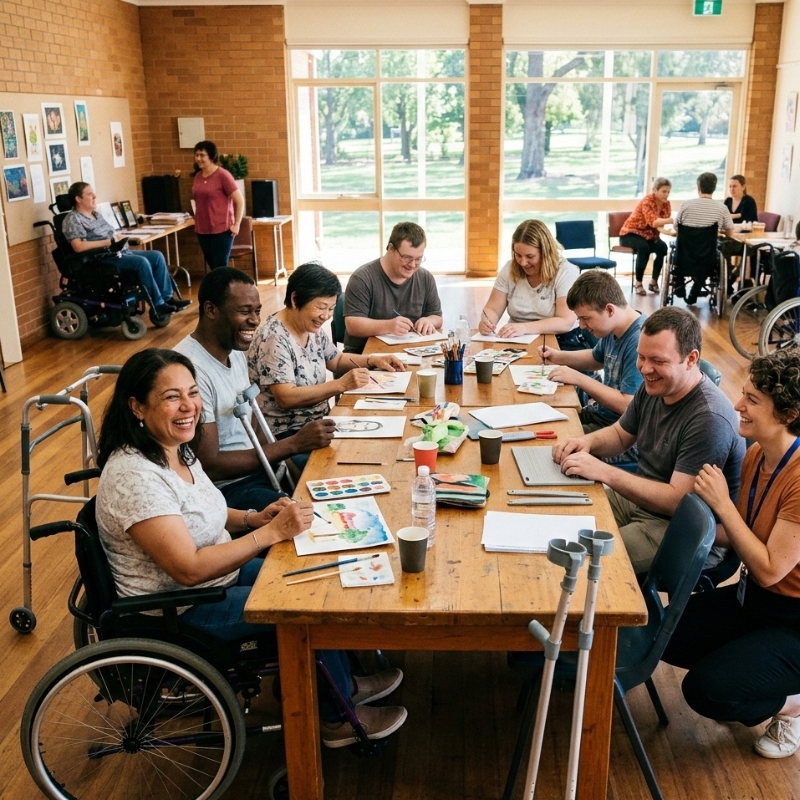
Choosing community activities on the NDIS can feel exciting and overwhelming at the same time. There are so many options in Melbourne—sports clubs, art classes, volunteering, libraries, social groups, community centres, festivals, gyms, short courses—and not all of them will feel like a good fit straight away.
The goal isn’t to pick the “best” activity on paper. It’s to find the activities that work for you in real life:
• they align with your goals
• they suit your interests
• they fit your access needs
• they’re realistic for your energy, routine and support setup
• they help you feel more connected, confident and capable over time
This guide walks you through a practical way to choose activities, try them safely, and build momentum—without burning out or wasting months on things that don’t feel right.
Start with your “why”, not a list of activities
Before you scroll through options or say yes to the first suggestion, get clear on why you want community activities in the first place.
Ask yourself (or talk it through with someone you trust):
• Do I want to make friends or feel less isolated?
• Do I want to build confidence in public spaces?
• Do I want to improve fitness, mobility or coordination?
• Do I want to learn skills for everyday life (shopping, cooking, transport)?
• Do I want routine and structure in my week?
• Do I want to explore interests, creativity, or volunteering?
• Do I want to practise communication, teamwork or emotional regulation?
A simple “why” statement can guide everything that comes next. For example:
• “I want one weekly activity where I can be around people who share my interests.”
• “I want to feel comfortable catching public transport to a familiar place.”
• “I want to build confidence speaking to new people in low-pressure settings.”
Match activities to your NDIS goals (and daily life)
Activities work best when they support a goal you’ve got in mind—especially if you’re planning supports around community access.
Even if your goals are broad, you can translate them into activity-friendly steps. Examples:
• Goal: “Increase social connection” → Activity: hobby group, social club, volunteering, structured group program
• Goal: “Increase independence” → Activity: community shopping practice, cooking class, travel training, library program
• Goal: “Improve confidence” → Activity: small group class with predictable routine, gradual exposure outings
• Goal: “Improve wellbeing” → Activity: gentle exercise class, walking group, community gardening
Then reality-check the practical side:
• time of day (morning vs afternoon)
• duration (60 minutes vs half-day)
• travel time (door-to-door)
• sensory environment (noise, lighting, crowds)
• recovery time needed afterwards
• cost extras (equipment, entry fees, snacks)
Sometimes the “perfect” activity becomes the wrong activity if it’s too far away, too long, or too unpredictable right now. You can always build toward it later.
If you’d like structured help translating goals into a weekly routine and choosing options that fit, these community participation supports can be used as a practical next step to explore what’s realistic and sustainable.
Use the Activity Fit Checklist before you commit
Here’s a simple way to choose activities without overthinking. Rate each item as:
• Easy
• Possible with supports
• Not right for now
Accessibility and environment
• Is the venue physically accessible (ramps, lifts, accessible toilets)?
• Is it sensory-friendly (lighting, noise, crowding, strong smells)?
• Is there a quiet space or an option to step out?
• Is the space easy to navigate (signage, layout, clear instructions)?
• Are communication supports welcome (Auslan, AAC, extra processing time)?
Social comfort and expectations
• Is it structured (clear start/end, rules, routine) or unstructured (free socialising)?
• How much talking is expected?
• Are there clear roles (coach/teacher/leader)?
• Is it okay to participate quietly at first?
• Are support people welcome if needed?
Support needs
• Do I need 1:1 support to attend safely or confidently?
• Would a group setting suit me better than 1:1?
• Do I need help with transport, money handling, communication, or personal care?
• What’s my plan if I feel overwhelmed?
Cost and logistics
• What are the out-of-pocket costs (materials, entry, membership, uniform)?
• Do I need equipment (shoes, art supplies, device, water bottle)?
• Is it close to home or near reliable transport?
• What happens if I need to cancel last minute?
Outcomes and enjoyment
• Does it connect to my “why”?
• Will I leave feeling better, the same, or worse most weeks?
• Is there a way to track progress (confidence, skills, routine, social contact)?
If an activity fails on one or two points, that doesn’t mean “no”. It might mean “not yet” or “yes, with the right supports”.
Choose the right type of activity for your current season of life
People often assume the “right” activity is whatever looks most social or most popular. But the right activity depends on what you can manage now.
Low-pressure activities for rebuilding confidence
These are great if anxiety, sensory overload, or fatigue has been a barrier:
• library programs or quiet interest groups
• art or craft sessions with a focus on the task (less talk required)
• gentle exercise (chair yoga, hydrotherapy-style movement, walking group)
• community gardening (structured, calming, outdoor space)
• short volunteering shifts with clear roles
Skill-building activities for independence
If your goals include everyday functioning:
• cooking or budgeting workshops
• supported shopping practice
• community travel practice (route planning, ticketing, asking for help)
• communication-focused groups (conversation skills, supported social practice)
Social activities for connection and friendships
If you’re ready for more interaction:
• hobby clubs (gaming, music, photography, cars, books)
• community sports clubs with inclusive options
• group outings with shared interests (museums, markets, events)
• peer groups (identity-affirming, culturally safe, disability-led communities)
Make “funding fit” simple and sensible
People get stuck trying to work out whether the NDIS will fund the activity itself. A helpful way to think about it is:
• The NDIS often funds supports that help you participate (like support worker time, skill-building support, capacity building supports) rather than paying for everyday costs anyone would pay (like regular club membership or movie tickets).
Funding decisions can be nuanced and individual, so it’s worth grounding your thinking in official guidance. The NDIS explains what it generally funds (and what it doesn’t) on its page about supports funded by the NDIS.
A practical rule of thumb:
• If the support is disability-related, helps you pursue your goals, and is reasonable for your circumstances, it’s more likely to be considered.
• If it’s an everyday expense unrelated to disability support, it’s less likely.
If you’re unsure, focus first on choosing activities that fit you well, then work backwards to organise the right kind of support to access them safely and consistently.
Do a 2–4 week trial (instead of overcommitting)
Many people quit activities not because the activity was wrong, but because the first experience was too big, too fast, or poorly supported.
A short trial makes it easier to succeed.
Trial plan: how to set it up
Pick one activity and define:
• trial length: 2–4 weeks
• frequency: once per week (or fortnight)
• goal for the trial: one simple outcome (not perfection)
Examples of trial goals:
• “Arrive, stay 30 minutes, and leave before I’m overwhelmed.”
• “Say hello to one person each session.”
• “Practise the same travel route with support.”
• “Learn the basic routine and decide if it’s enjoyable.”
Trial plan: what to track
After each session, quickly rate:
• Energy cost (low/medium/high)
• Enjoyment (0–10)
• Stress level (0–10)
• What helped
• What didn’t
• One change for next time
This is how you move from “I hated it” or “It was fine” to “Here’s exactly what needs adjusting”.
Plan for accessibility in Melbourne: practical tips that actually help
Melbourne has plenty of opportunities, but the “getting there and staying regulated” piece is what makes or breaks participation.
Transport planning tips
• Do a “dry run” at the same time of day you’ll attend (crowds can change everything).
• Build in extra time—rushing spikes stress.
• Identify a quiet stop, bench, or calm spot near the venue.
• Keep a simple exit plan: if you need to leave early, how will you do it?
Sensory and crowd planning
• Choose off-peak times where possible.
• Ask venues about quieter sessions, smaller classes, or flexible participation.
• Bring supports that help with regulation: headphones, sunglasses, fidgets, water, snacks, and comfort items.
Venue questions worth asking (short and direct)
• “Is there a quieter spot if someone needs a break?”
• “Is it okay if I step outside for a few minutes?”
• “Do you have accessible toilets?”
• “Can I observe or do a trial session first?”
• “Can instructions be provided in writing?”
Melbourne-specific idea sources can include your local council’s community directories, neighbourhood houses, libraries, and community centres. City-based accessibility and inclusion guides can also help you discover options you may not have considered.
Decide: 1:1 support, group support, or a mix?
The “right” activity sometimes depends on the type of support around it.
When 1:1 support can work well
• You need help with transport, communication, or safety
• you’re building confidence gradually
• you want to practise a specific skill (shopping, travel, routines)
• you need flexible pacing and breaks
When group settings can work well
• You enjoy shared structure and routine
• You find it easier when there’s a clear leader and a set activity
• You want a natural peer connection
• you’re practising social skills in a predictable environment
When a mix is best
A common pathway is:
• start with 1:1 support to learn the routine and build confidence
• transition to attending independently (or with less support) once it feels familiar
• add a second weekly activity later rather than doubling everything at once
If you’re weighing options and want a practical, goal-led approach, NDIS community activities support can help you map what support type fits each activity and how to step it up or down over time.
Use “small steps” to overcome anxiety, shutdowns, or avoidance
Avoidance isn’t laziness. It’s often your nervous system saying, “this feels unsafe” or “this is too much right now”.
Here are graded steps that work for many people:
• Step 1: watch a video or read about the activity (no commitment)
• Step 2: Visit the venue briefly at a quiet time
• Step 3: attend for 15–30 minutes and leave early
• Step 4: Stay for one full session
• Step 5: Try speaking to one person or joining a small part of the activity
• Step 6: repeat until it feels familiar
The magic is repetition with manageable effort. Familiarity builds safety.
Safety and boundaries: keep participation sustainable
Community participation should increase your independence and wellbeing—not leave you exhausted, overwhelmed, or unsafe.
Helpful boundaries:
• Have a clear “leave early” signal (a phrase, text, or gesture).
• Set a maximum time for the first few sessions.
• Schedule recovery time afterwards.
• Avoid stacking two big activities on the same day.
• Keep a simple safety plan for new places (who to call, where to wait, what to do).
If an activity involves new people, new environments, or higher risk (water activities, crowded events, travel at night), consider extra planning and support until it feels safe and familiar.
If you need practical help planning outings and building a routine that doesn’t tip into burnout, help with community access can support a step-by-step approach based on your needs and goals.
How to know you’ve picked the “right” activity
The right activity doesn’t always feel amazing on day one. But over a few weeks, you’ll usually notice signs like:
• it becomes easier to get ready and go
• the environment feels more predictable
• your stress reduces, or recovery time shortens
• you feel a sense of meaning, enjoyment, or pride
• you’re building skills or connection, even in small ways
• It fits your routine without taking over your whole week
If an activity repeatedly leaves you dysregulated for days, triggers shutdowns, or creates more distress than benefit, it’s okay to change course. That’s not failure—that’s learning.
FAQs
Can the NDIS pay for my class fees or membership?
Often, the NDIS is more likely to fund disability-related supports that help you participate (like support worker time, skill-building supports, or supports linked to your goals) rather than everyday costs that anyone would pay (like standard entry fees or memberships). For the most accurate guidance, check the NDIS information on supports and what’s generally funded.
How many activities should I do each week?
Start with one. Build consistency first. Once it feels manageable and you’re recovering well, add another. Two well-chosen activities that fit your energy is usually better than four that overwhelm you.
What if I don’t like group activities?
That’s completely fine. Many people prefer 1:1 skill-building in the community, interest-based activities that don’t require much talking, or small structured groups. The “right” format is the one you can actually stick with.
What if my support worker and I disagree on what activity I should do?
Bring it back to your goals and your lived experience. You’re the expert on what feels safe, meaningful, and sustainable. A good approach is a short trial with clear measures, then review together.