The short answer is that a nurse can perform clinical tasks and a support worker can’t. That line covers most of it, but the boundary isn’t obvious from the outside, and getting it wrong affects both safety and funding.
A support worker helps you live your day. A nurse manages a health need. Sometimes both happen in the same room, in the same hour, which is why families end up unsure who they should be asking for.
Where support work stops and nursing begins
The dividing line is clinical risk. If a task needs clinical judgement or training, it belongs to a nurse. If it’s part of ordinary daily living, it belongs to a support worker.
| Usually a support worker | Usually a nurse |
| Showering, dressing, moving safely | Wound care and dressing changes |
| Meals and help with eating | Catheter or stoma care |
| Prompting medication already prepared | Administering medication, including injections |
| Exercises set by a therapist | Assessing a change in health |
| Housework, laundry, shopping | Enteral feeding, diabetes management |
Note the word “usually”. Some tasks move across that line under formal delegation. As a rule of thumb, if a registered practitioner would need to sign off on how the task is done, it’s nursing.
For everything on the left, what you want is day to day help with personal activities rather than clinical care.
The three words people mix up: prompting, assisting, administering
| Term | What it means | Who can generally do it |
| Prompting | Reminding someone it’s time, without handling the medication | Support worker |
| Assisting | Helping with practical steps while the person self administers | Support worker, within scope |
| Administering | Giving the medication, including anything injected or measured | Nurse, or a worker under formal delegation |
The wording matters because the training, oversight and record keeping differ for each one. A provider describing administering as prompting is misrepresenting what it does.
Delegation is the fourth arrangement. A registered nurse can delegate a specific clinical task to a support worker who has been trained and assessed for it, while keeping responsibility and supervision. That’s documented, not decided on the spot. If you’re told support workers can do a clinical task, ask who delegated it and who supervises it.
What community nursing looks like in someone’s home
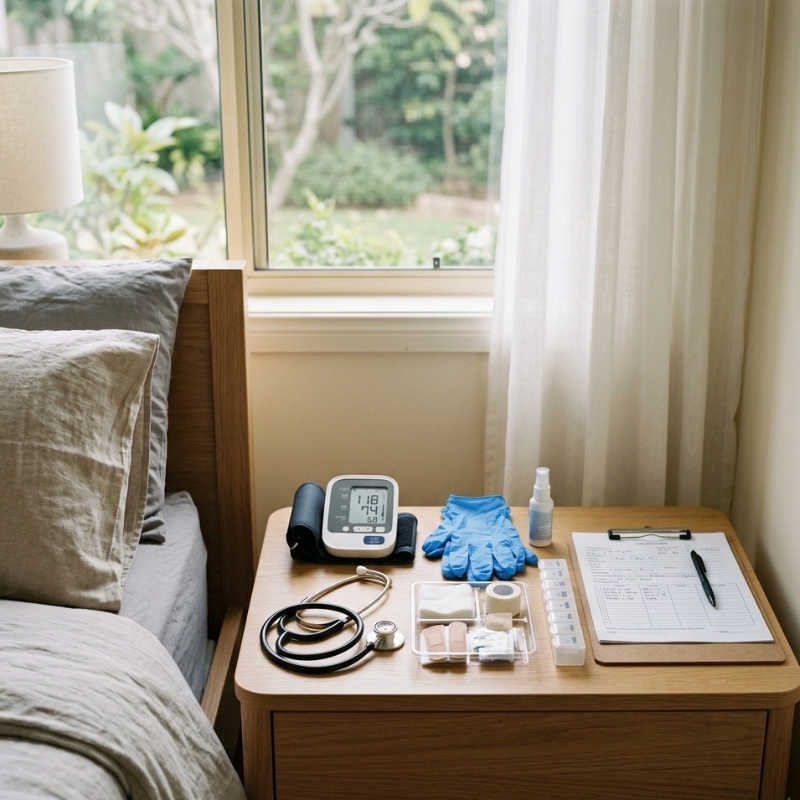
Community nursing means clinical care delivered where you live. The NDIS funds it where the health need relates to your disability and can reasonably be met at home. It commonly covers:
- Wound and pressure area care
- Continence assessment and management
- Catheter and stoma care
- Enteral feeding and tube management
- Medication administration and chart management
- Respiratory support, including tracheostomy care
- Training and supervision of support workers on delegated tasks
Health monitoring is easy to overlook and often the most valuable part. A pressure area caught at stage one is a dressing. Caught at stage three it’s an admission. All of the above describes what the NDIS funds generally, not what any particular provider performs.
Which part of your plan pays for nursing
Nursing is priced by the level of practitioner delivering the care, so an assessment by a registered nurse and a routine visit by an enrolled nurse are claimed differently. Complex and high-intensity supports sit in their own part of the structure, with extra requirements about who can deliver them. Prices are limits, not fixed fees.
Because the categories and item structure are reviewed each year, read the current version rather than an old copy. You can see how supports are priced on the current pricing schedule on the NDIS website. If a provider quotes a figure, ask which item code it’s claimed against.
When one week needs both a nurse and a support worker
Most people who need nursing at home don’t need only nursing. A dressing change might be twenty minutes twice a week. The showering, meals and housework around it might be fifteen hours.
The temptation is to shift as much as possible into the cheaper hours. That works until it doesn’t. If a clinical task is done by someone without the training to notice a problem, the saving disappears the first time a wound gets infected.
Better to be precise about which hours genuinely need a clinician. Nursing visits get scheduled first, and how in home support is usually rostered follows from there.
How to check a nursing provider before you commit
Nursing is a regulated health service, so there’s more you can verify here than with most supports.
| What to check | Where |
| The individual nurse’s current registration | The register of practitioners on the AHPRA website |
| That the organisation is registered | The provider finder run by the NDIS Commission |
| Which registration groups they hold | Registration is granted for specific groups, not in general |
| Clinical governance | Ask who the supervising registered nurse is |
Two practical notes. AHPRA registration belongs to the individual, so searching a company name won’t work. And being registered doesn’t mean being registered for the thing you need.
Our registration number is 4-L7JCZ6S, and you’re welcome to check it. There’s more on our nursing support across Melbourne and Sydney if you want the detail.
Getting nursing supports into your plan
Nursing is usually added on the strength of clinical evidence, so the paperwork matters more here than for most supports. What helps:
- A letter from the treating clinician describing the need, the frequency, and why it needs a nurse
- A discharge summary, if the need came out of a hospital admission
- A wound or continence assessment where one exists
You don’t have to wait for a scheduled review. A reassessment can be requested when circumstances change, and a new clinical need is exactly that. Be specific about consequences, because “without a fortnightly dressing change this wound is likely to require readmission” carries more weight than “nursing support would be beneficial”.
Talk to us about what your plan needs
If you’re unsure whether you need nursing or support work, that’s a normal question and worth a conversation rather than a guess.
Ahsan Care Provider is a registered NDIS provider, number 4-L7JCZ6S, at 13/22 Makland Dr, Derrimut VIC 3030, Monday to Friday 9am to 5pm. Quotes are free, there’s no call out fee, and the price you’re quoted is the price you pay.

